
Yash Pataskar
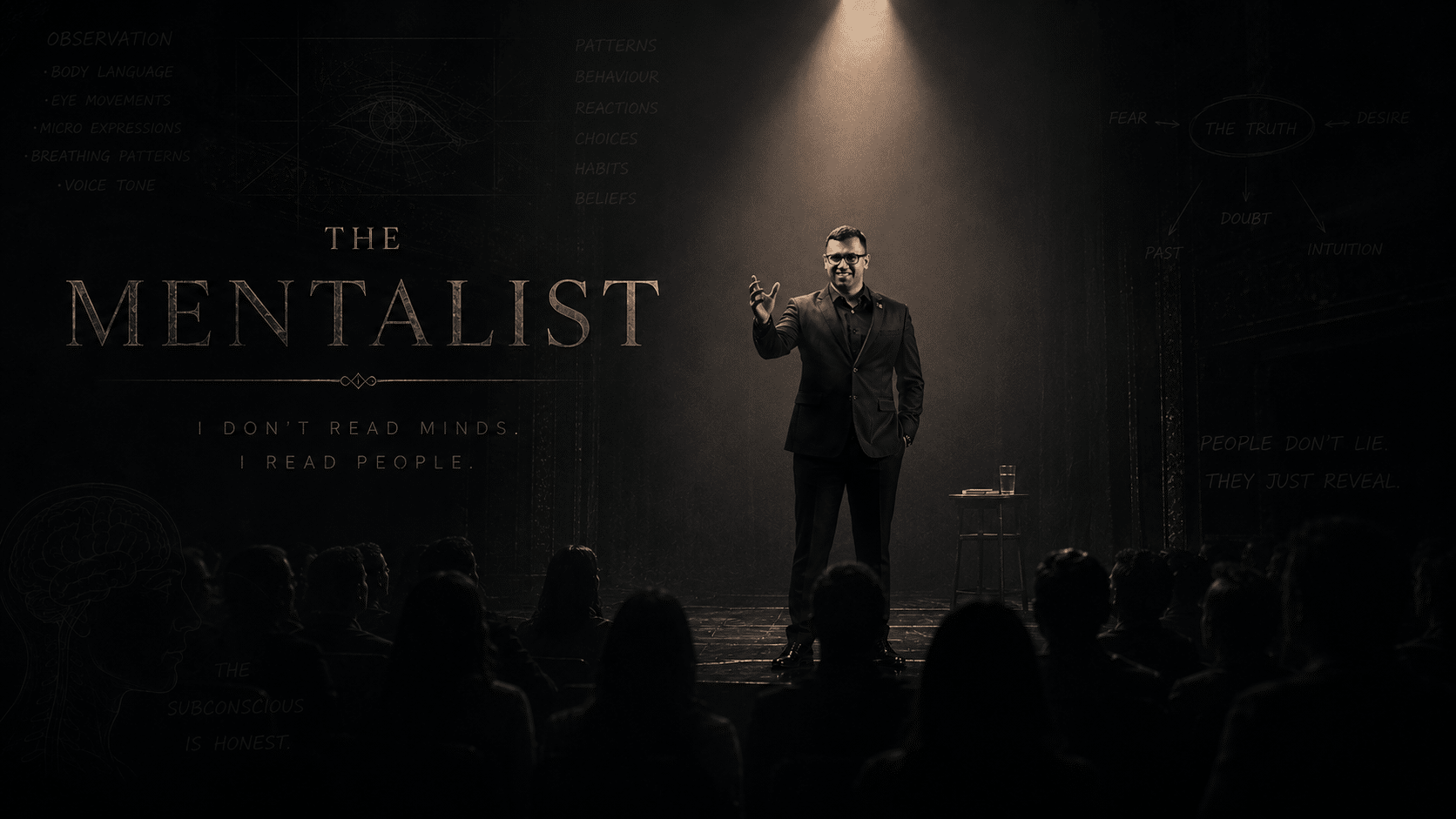
Your thoughts feel private, but they seldom are.
A deep dive into psychology, perception, suggestion, and the fascinating science behind mentalism.
A mentalist walks onto a stage.
A stranger thinks of a word silently.
- No phones.
- No writing.
- No speaking.
Moments later, the thought is revealed.
The audience reacts instantly:
- disbelief
- amazement
- goosebumps
And almost everybody asks the same question:
“Can mentalists really read minds?”
It is one of the oldest and most fascinating questions surrounding mentalism.
Because when performed well, mentalism does not merely look impressive, it feels impossible.
But the truth behind mentalism is far more interesting than supernatural powers.
Mentalism lives at the intersection of:
- psychology
- perception
- behavioural science
- suggestion
- observation
- theatre
- human thoughts
And understanding why mentalism works reveals something extraordinary about the human mind itself.
To understand this deeper, it helps to explore the complete Psychology Behind Mentalism and how perception shapes human experience.
What Is Mentalism?
Mentalism is a performance art designed to create the illusion of extraordinary mental abilities.
A mentalist may appear to:
- read thoughts
- predict decisions
- influence choices
- detect lies
- reveal hidden information
- manipulate perception
Unlike traditional magic, mentalism focuses less on physical impossibilities and more on psychological impossibilities.
That distinction matters enormously.
Because mentalism feels personal.
The subject is not cards or objects.
The subject is you.
Your decisions.
Your thoughts.
Your memories.
Your behaviour.
And that is why mentalism often creates stronger emotional reactions than visual illusions alone.
So… Can Mentalists Actually Read Minds?
The short answer: No. Not literally.
Modern mentalism is not supernatural telepathy.
Professional mentalists use a sophisticated combination of:
- psychology
- behavioural observation
- suggestion
- influence
- memory manipulation
- theatrical methods
- audience management
- perception control
The experience feels like mind reading because the brain naturally tries to explain impossible outcomes using the most dramatic explanation available.
And sometimes:
“He read my mind”
feels emotionally simpler than:
“My perception was expertly guided.”
The Human Brain Is Easier to Influence Than Most People Realize
One reason mentalism feels convincing is because human perception is not objective.
Your brain constantly:
- filters information
- fills gaps automatically
- predicts outcomes
- searches for patterns
- ignores unnecessary details
Psychologists have studied these mechanisms extensively. Publications like Psychology Today and Verywell Mind frequently discuss concepts such as cognitive bias, selective attention, and behavioural influence that directly relate to how audiences experience mentalism.
Mentalists understand these invisible pathways deeply.
Not very unlike architects understanding hidden structural beams inside a building.
How Mentalists Create the Illusion of Mind Reading
1. Observation
Humans constantly reveal information unintentionally:
- body language
- facial reactions
- speech patterns
- verbal hesitation
- eye movement
- breathing changes
- fidget and fumble
A profesional mentalist notices details most people miss.
Sometimes the audience interprets that accuracy as supernatural insight.
2. Suggestion
Subtle wording can influence decisions more than people realize.
The order of words, tone, pauses, emphasis, and framing can gently guide thought patterns.
This is one reason mentalism often overlaps with:
- persuasion psychology
- behavioural science
- communication theory
3. Psychological Forces
A psychological force is a technique where the audience feels they made a completely free choice while the outcome was subtly influenced.
This creates one of the strongest reactions in mentalism because people deeply trust their own sense of free will.
When that certainty cracks, astonishment enters immediately.
4. Attention Control
Mentalists carefully guide audience attention.
Humans naturally focus on limited details while filtering everything else.
This principle, often discussed in cognitive psychology, is called selective attention.
The remarkable part is not that attention can be redirected.
The remarkable part is how convinced the brain becomes that it noticed everything.
Why Mentalism Feels More Powerful Than Magic
Traditional magic often focuses on objects:
- cards
- coins
- boxes
- visual illusions
Mentalism focuses on:
- thoughts
- memories
- choices
- emotions
- intuition
That psychological intimacy changes everything.
Mentalism feels less like watching something happen…
…and more like experiencing something happen inside your own mind.
That is why reactions during mentalism performances are often emotional, stunned, and deeply personal.

Is Mentalism Based on Real Psychology?
Yes. And so much more than just that.
Mentalism often incorporates genuine psychological principles involving:
- influence
- perception
- behavioural prediction
- memory
- communication
- observation
But it is also important to understand:
mentalism is theatre.
Performance structure matters enormously.
Timing. Storytelling. Confidence. Framing. Suspense.
A mentalist is not merely demonstrating psychology. He is orchestrating a world-class experience.

Why Audiences Want to Believe
This is perhaps the most interesting part of all.
People do not attend mentalism shows because they desperately want factual explanations.
They attend because modern life rarely leaves room for mystery anymore.
Algorithms predict:
- music
- movies
- routes
- purchases
- conversations
Mentalism briefly restores uncertainty & surprise.
And that creates wonder.
For a few moments, the audience experiences something ancient: the feeling that reality may be larger than they assumed.
Mentalism in Corporate Events and Weddings
Mentalism has become increasingly popular at:
Why?
Because it transforms passive audiences into active participants.
Interactive entertainment creates stronger emotional memory than passive observation. Event industry platforms like Event Marketer and BizBash frequently highlight immersive experiences as a major trend in modern events.
Mentalism thrives in exactly those environments.
The Real Secret Behind Mentalism
The greatest illusion in mentalism is not hidden inside props or secret devices.
It lives inside human certainty.
People trust:
- their memory
- their perception
- their decisions
Mentalism gently demonstrates how flexible those systems truly are.
And perhaps that is why audiences never forget it.
Not because they witnessed supernatural powers, but because they briefly witnessed the strange architecture of their own minds.

Frequently Asked Questions – FAQs
Can mentalists really read minds?
Mentalists do not literally read minds. Modern mentalism combines psychology, observation, suggestion, performance techniques, and audience interaction to create the illusion of mind reading.a
Is mentalism real or fake?
Mentalism is a real performance art, but it is generally theatrical rather than supernatural. The psychology and behavioural principles involved are genuine.
How do mentalists know what people are thinking?
Mentalists may use observation, psychological techniques, probability, suggestion, and performance methods to create highly convincing demonstrations.
Want to Book The Pinnacle of Entertainment in India?
Yash Pataskar is known as the Pinnacle of Entertainment in India and all over the world. An International Artist and Performer, Yash has been creating spell-binding illusions in the minds of his audience from around the world and is invited by Fortune 500 Companies, the VIPS and some of the biggest names in the world.
Click on the button below to secure your dates!